The Transparency Debt Created by Undocumented Model Updates

Imagine that a public agency evaluates a language model on Friday. On Monday, staff repeat the same test against what appears to be the same model. The answers are materially different.
The change might reflect a provider update. It might come from a mutable model alias, a revised safety policy, altered tool access, stochastic variation, or a flaw in the agency’s test. Without a durable version record, the agency cannot distinguish among those explanations. Its earlier evidence still exists, but its meaning has become uncertain.
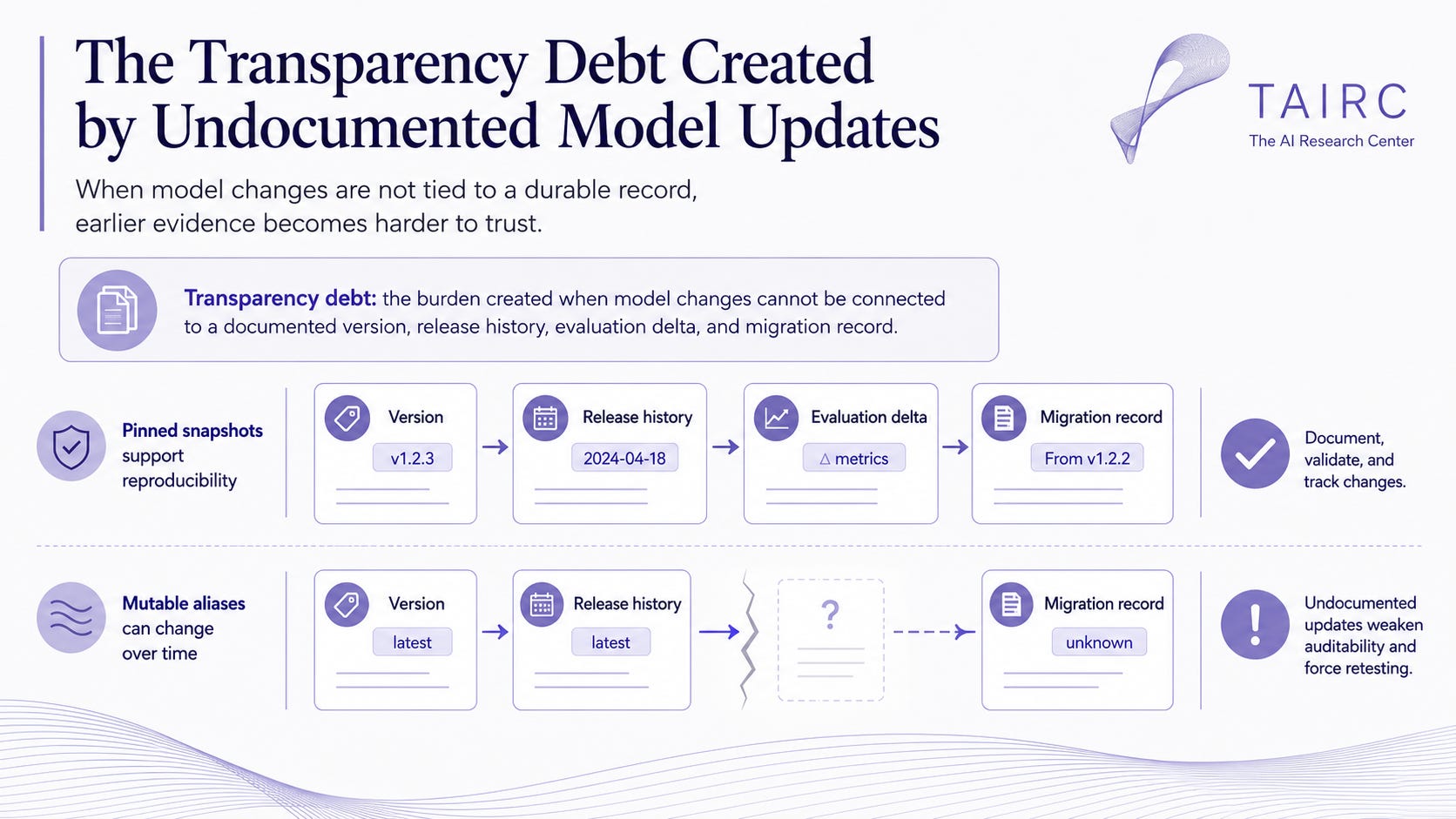
That uncertainty is transparency debt: the cumulative burden created when changes to an AI system cannot be connected to a sufficiently documented version, release history, evaluation delta, and migration record.
The immediate cost is more testing. The deeper cost is damaged auditability. Each undocumented change forces downstream users to reconstruct what happened, determine which earlier findings remain valid, and decide whether decisions based on those findings must be reconsidered. Some evidence may be recoverable. Some may be gone for good.
The governing question is therefore larger than whether an updated model performs better. It is whether an institution can still explain which system it evaluated, what changed, what evidence survived the change, and where human judgment replaced missing information.
The same model name can describe different evidentiary conditions
A model identifier can function as a permanent reference or as a moving target.
Anthropic’s current documentation describes its Claude model identifiers as pinned snapshots: a dated identifier refers to a fixed model version and does not change after release. That design lets an evaluator identify the model that produced a result even after newer versions become available. (Claude Platform Docs)
Google’s Gemini documentation distinguishes stable, preview, experimental, and “latest” identifiers. Stable versions ordinarily remain fixed, while a “latest” alias can be replaced as new releases become available. Google states that breaking changes to such an alias receive advance notice, but the alias itself remains intentionally mutable. (Google AI for Developers)
OpenAI’s deprecation policy addresses a related part of the lifecycle. It acknowledges that software relying on models may require updates when models or endpoints are retired, publishes deprecation notices, provides different minimum notice periods by release category, and recommends testing replacements before migration. (OpenAI)
None of these approaches is inherently irresponsible. A mutable alias can help users receive improvements without changing an integration. A pinned snapshot can improve reproducibility while requiring deliberate migrations. Deprecation schedules can reduce long-term maintenance burdens while disrupting studies that depend on retired systems.
The transparency debt arises when the evidentiary consequences of those choices are not understood or recorded. An institution that evaluates a mutable alias as though it were a fixed scientific instrument has created a provenance problem before the first update occurs.
An update can be beneficial and still create debt
Model updates are often necessary. Providers may correct defects, strengthen safeguards, improve reliability, reduce costs, or replace obsolete infrastructure. Requiring systems never to change would preserve reproducibility by freezing known weaknesses in place.
The relevant distinction is not change versus stability. It is documented change versus untraceable change.
Suppose an update improves performance on most tasks but changes refusal behavior on a narrow category of requests. A provider may reasonably describe the release as an improvement. A university studying refusals, however, now has a different experimental object. A newsroom checking whether the system invents citations may need to repeat its tests. A government team using the model to summarize public documents may need to reassess whether its earlier validation still applies.
The update can be good in aggregate while invalidating a specific body of evidence.
Research on model behavior over time illustrates why this distinction matters. Lingjiao Chen, Matei Zaharia, and James Zou compared March and June 2023 versions of GPT-3.5 and GPT-4 across several tasks. They found substantial behavioral differences, with some measured outcomes improving and others declining. They also showed that conclusions could depend on how performance was measured: generated code that initially appeared less executable performed better after superficial formatting was corrected. (Harvard Data Science Review)
That study did not prove that language models inevitably deteriorate after updates. It showed that a result attached to one snapshot cannot automatically be transferred to another.
Arvind Narayanan and Sayash Kapoor later argued that public discussion of the study frequently blurred the distinction between capability and observed behavior. A different answer under one prompt or scoring method does not establish that the underlying system has become less capable. Prompt sensitivity, formatting conventions, and evaluator design can all affect the result. (Normaltech)
The criticism strengthens the case for update transparency. A behavioral difference is evidence that something changed in the measured interaction. It is not, by itself, evidence of why the change occurred.
Opacity converts a measurable difference into an argument about causes.
Transparency debt accumulates across institutions
The first institution to notice a changed result bears only part of the cost. The debt spreads through every organization that relied on the earlier evaluation.
Researchers may discover that an experiment cannot be reproduced because the tested endpoint no longer resolves to the same system. Procurement teams may compare vendor reports produced against different snapshots without realizing that the underlying conditions differ. Journalists may cite an old evaluation as evidence about a current service. Policymakers may rely on findings whose model, prompt configuration, retrieval layer, or safety behavior has since changed.
A missing update record also weakens comparison. Two institutions can use the same benchmark and report different outcomes without testing the same effective system. One may have used a pinned snapshot; another may have called a mutable alias weeks later. Their disagreement may appear methodological when it is partly temporal.
Reproducible evaluation frameworks attempt to reduce this ambiguity by preserving the conditions surrounding a result. Stanford’s HELM project, for example, publishes model, scenario, prompt, metric, and run-level information so that readers can inspect how reported results were produced. The point is not that documentation eliminates every source of variation. It gives later investigators a record from which variation can be examined. (Stanford CRFM)
NIST’s AI Risk Management Framework takes a similar institutional view. Its measurement guidance calls for models to be explained, validated, and documented and for identified risks to be tracked over time. The associated Playbook recommends documenting test sets, metrics, and tools so that evaluations can be repeated consistently. (NIST AI Resource Center)
NIST also treats change management as a governance responsibility. Its guidance calls for mechanisms to communicate substantial changes and advises organizations to review third-party release schedules, patches, updates, compatibility information, and change-management practices for conditions that may introduce additional risk. (NIST AI Resource Center)
These are not clerical requirements. They determine whether a claim remains inspectable after the system changes.
The real trade-off is inspectability versus unrecorded judgment
Discussions about AI updates are often framed as a contest between innovation and caution. Faster releases supposedly produce better systems; slower review supposedly produces safer institutions.
That framing misses the central governance choice.
An institution can move quickly and preserve evidence. It can record the exact model identifier, date the evaluation, retain the prompts and test materials it is permitted to retain, document tool and retrieval settings, preserve outputs and scoring procedures, and specify which conclusions apply only to that configuration. When a provider announces a relevant change, the institution can rerun the tests tied to the affected claim.
The alternative is not necessarily faster. It merely transfers work into the future. Staff must later reconstruct configurations from logs, infer which endpoint was used, search for release notes, and decide whether an old result described the model, the surrounding application, or a transient interaction. Senior reviewers then make consequential judgments from an incomplete record.
That is the point at which transparency debt becomes institutional risk. Missing documentation does not remove the need for a decision. It causes the decision to depend more heavily on memory, assumption, and authority.
The appropriate review gate depends on the claim being made. A low-stakes demonstration may require little more than a dated disclosure that outputs can change. A comparative evaluation intended to influence procurement requires a much stronger chain of provenance. A test supporting use in a consequential public workflow may need to be repeated whenever a relevant model, prompt, retrieval source, safety layer, or scoring process changes.
No universal retesting schedule can substitute for that judgment. The trigger should follow the claim. The stronger the claim and the greater the consequence of error, the stronger the evidence needed to carry it across an update.
A missing record limits what can responsibly be claimed
When an institution cannot identify the effective version of a model, it should narrow its language.
It may report that a particular output was observed on a particular date. It cannot responsibly present that observation as a stable property of every current or future version. It may describe a difference between two runs. It cannot attribute the difference to a model update unless the relevant change is established. It may decide that an old evaluation no longer supports an operational conclusion. It should not claim that the underlying system became safer or less safe without evidence that isolates the cause.
This restraint is especially important when evaluation results travel beyond their original context. A benchmark score can be copied into a procurement memo, a news article, an academic introduction, or a policy briefing long after the tested system has changed. The caveats usually travel less reliably than the number.
Transparency research suggests that market visibility does not guarantee adequate disclosure. Stanford’s 2025 Foundation Model Transparency Index reported that the average score among evaluated companies fell from 58 in 2024 to 40 in 2025. The researchers identified continued opacity around areas including training data, computing resources, downstream use, impact, and the methodology behind some evaluations. The index is broader than model-update documentation, but its findings undermine the assumption that competitive pressure will steadily produce more complete records on its own. (arXiv)
The correct response is not to treat every undocumented change as evidence of misconduct. Providers face legitimate constraints. Detailed disclosures can expose security-sensitive information, proprietary implementation choices, or misuse-relevant weaknesses. Some infrastructure changes may have no material effect on the claims an evaluator is testing.
A proportional record does not require publication of model weights, private training data, or exploitable technical details. It requires enough information for affected users to identify the changed artifact, understand the intended scope of the change, determine whether earlier evaluations may be affected, locate a stable replacement when one exists, and know when a migration or retest is necessary.
The standard is sufficient inspectability, not total disclosure.
Institutions should pay the debt before making the next claim
When an undocumented change is suspected, the first task is not to explain the change. It is to establish what is known.
The institution should preserve the earlier result and its available provenance rather than overwriting it with a new run. It should identify whether the model reference was pinned or mutable, review available provider notices, and repeat the evaluation under controlled conditions where the claim matters. Results from different effective versions should remain separated. Unresolved causes should remain unresolved in the published language.
Human review becomes decisive when the missing record affects a consequential conclusion. A reviewer must decide whether the evidence still supports publication, comparison, procurement, continued use, or no conclusion at all. That judgment should be recorded with the same care as the model result, because it marks the boundary between observed evidence and institutional interpretation.
This approach does not certify a model as reliable, safe, or suitable. TAIRC’s Open LLM Transparency and Evaluation Frameworks program is explicitly limited to analytical evaluation, documentation, reproducibility, and public accountability. It does not train proprietary large-scale models, endorse commercial systems, issue regulatory approval, or treat an evaluation as a universal guarantee. TAIRC’s broader research portfolio likewise places evaluation before deployment and confines its work to defined nonprofit research and governance boundaries.
Those boundaries matter because transparency cannot eliminate uncertainty. A complete release note cannot reveal every behavioral consequence of an update. A pinned snapshot cannot guarantee that an external dependency, hosted environment, or evaluator has remained unchanged. A reproducible test cannot prove performance on every population, task, language, or future condition.
Documentation does something narrower and indispensable: it makes uncertainty locatable.
The debt comes due at the moment of accountability
Return to the agency whose Monday result no longer matches Friday’s.
The agency does not yet know that the model regressed. It does not know that the provider improved it. It does not know whether the difference originated inside the model at all.
What it knows depends on the record.
With a pinned identifier, dated configuration, preserved test, documented scoring method, and accessible change history, the agency has an investigable discrepancy. Without them, it has competing explanations and a decision deadline.
That is the practical meaning of transparency debt. It is the distance between observing a change and being able to account for it.
A model may improve overnight. An institution’s evidence cannot improve retroactively.
Sources and verification
TAIRC’s organizational scope and research boundaries were verified against the attached description of the Open LLM Transparency and Evaluation Frameworks program and the TAIRC Research Portfolio.
The governance and evaluation principles were verified against the National Institute of Standards and Technology’s AI Risk Management Framework Core and its official Playbook guidance on measurement, documentation, risk tracking, third-party updates, and change management. (NIST AI Resource Center)
Current model-version and lifecycle practices were verified against official documentation from Anthropic, Google, and OpenAI. (Claude Platform Docs)
Evidence concerning behavioral variation between model snapshots was drawn from Chen, Zaharia, and Zou’s “How Is ChatGPT’s Behavior Changing Over Time?” and was interpreted alongside Narayanan and Kapoor’s critique distinguishing observed behavior from underlying capability. (Harvard Data Science Review)
The discussion of reproducible evaluation records was informed by Stanford’s HELM documentation, while the broader disclosure context was verified against the 2025 Foundation Model Transparency Index. (Stanford CRFM)